

Introduction
Few commodities encapsulate the intersection of history, inequality, climate vulnerability, and global capitalism as vividly as cocoa and coffee, t
hese goods are some of the most familiar products in the world economy, but also among the most misunderstood.
They appear in daily life as routine pleasures:
an espresso to start the morning, a chocolate bar, a cappuccino in a fancy coffee shop, a box of pralines gifted for San Valentines.
Yet their apparent normality conceals a deeply political geography.
Both commodities are overwhelmingly grown in tropical regions of the Global South, often by smallholders exposed to price swings and environmental stress,
while the most profitable stages of processing, branding, finance, and retail remain concentrated in richer consuming economies. That asymmetry is not incidental. It is the legacy of empire, and it continues to shape how both markets function today.
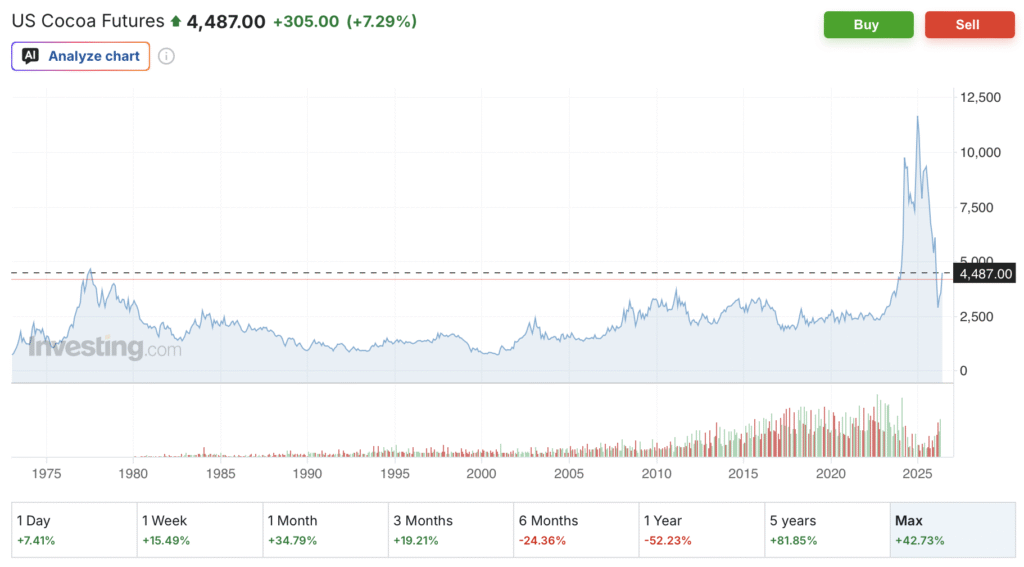
The result is that coffee and cocoa are no longer just agricultural commodities. They are strategic goods at the intersection of trade policy, climate security, corporate concentration, and state stability. The volatility of the last two years has made that especially clear. In cocoa, a weather- and disease-driven supply shock in West Africa helped send prices from roughly $3,000 a tonne to around $12,000 by late 2024, before a sharp reversal.
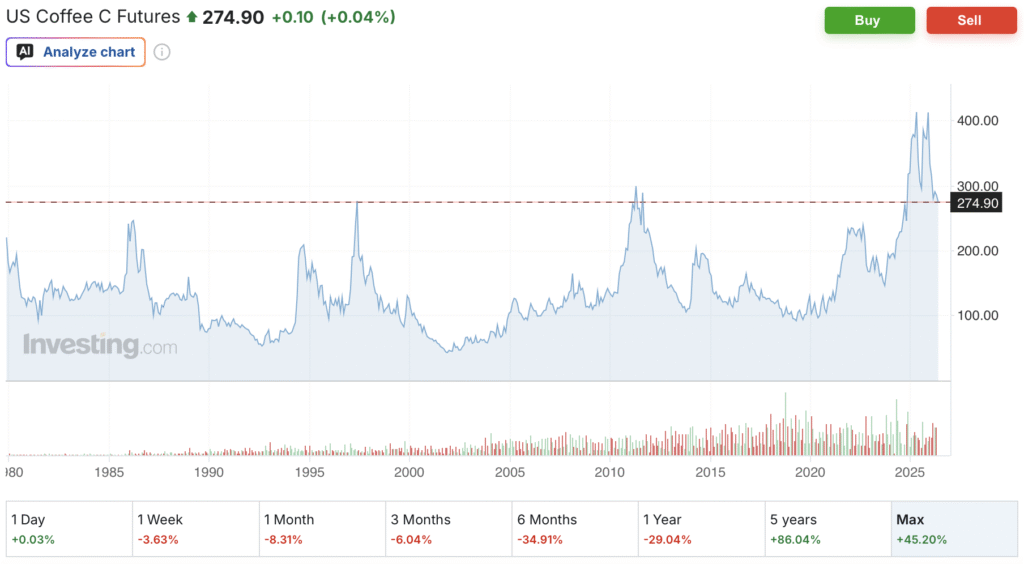
In coffee, tight supply and weather disruptions lifted prices to exceptional levels before improved outlooks in Brazil and Vietnam began to cool the market.
Behind those price charts lies a bigger geopolitical story:
who controls supply, who captures value, who absorbs risk, and which states are most exposed when these chains break down.
A brief history: consumption, colonialism, and the making of unequal markets
The history of coffee and cocoa consumption is inseparable from colonial expansion.
Cocoa was cultivated in Mesoamerica for more than three millennia before Europeans arrived; it entered Europe after the Spanish conquest and gradually evolved from an elite imported drink into a mass commodity.
Coffee originated in Ethiopia, was cultivated in Yemen by at least the fifteenth century, and then spread through imperial trade networks into Europe, Asia, and the Americas.
What turned both into global staples was not taste alone, but empire: colonial land appropriation, plantation systems, coerced labor, and mercantilist trade.
By the early modern period, coffee and chocolate had become part of Europe’s wider appetite for “colonial luxuries,” alongside sugar and tea.
In parallel, production systems hardened into a familiar pattern: tropical producers exported raw material, while metropoles captured commercial and industrial value. That structure still defines both sectors.
Cocoa’s later history in West Africa illustrates this especially clearly.
Britannica notes that cocoa became the most valuable export of the Gold Coast, later Ghana, by 1913, and by the 1920s the colony was producing more than half of the world’s supply.
Colonial institutions did not merely facilitate trade; they organized territories around export agriculture and tied local livelihoods to distant consumer markets. In that sense, the modern cocoa economy was not simply inherited from colonialism; it was built by it.
Coffee: a more diversified market, but not a less political one
Coffee differs from cocoa in one major respect:
it is produced across a broader range of countries and is therefore somewhat less geographically concentrated.
According to the FAO, coffee is the world’s most widely traded tropical product, with up to 25 million farming households accounting for about 80 percent of output.
Brazil, Vietnam, and Colombia remain the leading producers, while the European Union and the United States are the largest importing and consuming markets. The basic geography of the sector therefore still reflects the old colonial division of labor: cultivation in the South, demand and high-value retail in the North.
Recent market developments show both the resilience and fragility of that system. Trade flows remain strong.
World coffee exports reached 11.46 million bags in February 2026, and exports in the first five months of coffee year 2025/26 rose 4.5 percent to 57.77 million bags, compared with 55.3 million bags a year earlier.
The underlying trade map is shifting.
In January 2026, according to the ICO’s February market report, global exports of all forms of coffee rose 13.7 percent year-on-year to 12.62 million bags. Exports from Asia and Oceania surged 54.4 percent, driven above all by Vietnam, whose shipments jumped 67 percent to 4.33 million bags, a record for January. By contrast, South American exports fell 21.3 percent, with Brazilian exports down 25.5 percent and Colombian exports down 19.4 percent.
This matters geopolitically because it shows that the coffee market is not merely responding to aggregate supply; it is being actively reweighted across producing regions. Vietnam’s robusta strength, Uganda’s expansion, and Brazil’s weather-linked volatility are changing bargaining positions and trade routes inside the sector.
Climate remains the central destabilizer.
Reuters reported in April 2025 that Brazil’s 2025/26 coffee output was forecast to decline by 3 to 6.4 percent because dry weather in 2024 damaged flowering, with arabica especially affected. The same report noted that robusta was expected to perform better, offsetting some losses. This split is crucial.
Arabica remains the prestige bean in much of the premium market, but robusta has become increasingly strategic because it is cheaper, more resilient in some environments, and ever more relevant for blends and soluble coffee.
In other words, climate change is not only threatening coffee volumes; it is reshaping the internal political economy of the bean itself.
At the consumer end, high prices are already feeding behavioral change. In March 2026 some market analysts expected coffee to follow cocoa downward, with high prices hurting demand and prompting cost-cutting. Whether that exact trajectory materializes is secondary. What matters is the mechanism: when prices surge, producers do not automatically become the winners. Downstream actors, roasters, brands, retailers, often have more capacity to hedge, substitute, reblend, delay purchases, or pass costs on. Producers, by contrast, remain exposed to weather, credit costs, and weak local infrastructure. The FAO itself warns that recurrent market imbalances and asymmetric income distribution threaten millions of smallholders.
Cocoa: the market where concentration becomes vulnerability
If coffee is a global market with multiple pivots, cocoa is a global market with a structural choke point. Ghana and Côte d’Ivoire together produce nearly 50 percent of world cocoa output. When West Africa suffers climatic stress, disease, logistical disruption, or policy failure, the entire market feels it immediately. That is precisely what happened during the cocoa crisis of 2024–25.
The latest official numbers from the ICCO suggest that the most acute phase of the shortage has eased, but not that the system is healthy.
In its February 2026 Quarterly Bulletin, the ICCO revised the 2024/25 global cocoa balance to a 75,000-tonne surplus, with world production at 4.728 million tonnes and grindings at 4.606 million tonnes.
That is a significant rebound from 2023/24, when output stood at 4.362 million tonnes and the market ran a 492,000-tonne deficit. End-of-season stocks are now estimated at 1.347 million tonnes, and the stocks-to-grindings ratio has recovered to 29.2 percent. On paper, that is stabilization. In political terms, however, it is stabilization after a systemic scare.
The problem of concentration
That problem is intensified by corporate concentration downstream. UNCTAD found that, following industry consolidation, four processing companies controlled nearly two thirds of global cocoa grindings capacity in 2015.
It also noted that in Côte d’Ivoire the top five grinders accounted for nearly 85 percent of national grinding capacity, and that these were largely transnational corporations or their subsidiaries.
This is one of the most important geopolitical facts about cocoa: producing countries may host more grinding than before, but the value created there is still often captured by foreign capital. The geography of processing has shifted somewhat; the geography of power has shifted much less.
Cocoa is also the commodity in which regulatory geopolitics is currently most visible.
In December 2025 the EU’s anti-deforestation law was delayed again, with compliance now due from 30 December 2026 for large companies and 30 June 2027 for smaller firms. The law will require due diligence proving that imported commodities such as cocoa are not linked to deforestation.
At the same time, Reuters reported today that industry and NGO actors in the UK are pushing for parallel forest-risk regulation, arguing that the current system leaves traceability investment too weak and risks turning Britain into a “dumping ground” for illegal cocoa. The same Reuters piece cites research saying that only 73 percent of cocoa entering Europe is currently deforestation-free.
These rules are not just environmental policy. They are instruments of market power.
They allow the EU and, potentially, the UK to set the conditions under which tropical producers can access lucrative consumer markets.
That may improve traceability and reduce forest loss; it may also raise compliance costs and squeeze out smaller cooperatives unless buyers and governments share those costs.
Reuters quotes sector actors warning that smallholder farmers, who grow 80 to 90 percent of the world’s cocoa, bear the most risk. This is the core geopolitical tension: sustainability governance is increasingly being written in consuming markets, while implementation burdens fall at origin.
Big companies, climate shock, and political stability
In both coffee and cocoa, the decisive actors are not only farmers and states but also the multinational firms that sit between them and final consumers.
In cocoa the concentration is easier to document, but the same structural logic exists in coffee: producers are numerous and fragmented, while downstream capital is better organized, better financed, and better able to manage price risk. The FAO’s warning about asymmetric income distribution in coffee, and UNCTAD’s findings on cocoa concentration, point to the same reality. Value chains that look global are, in practice, systems for allocating risk downward and profit upward.
Climate change then compounds those imbalances.
In cocoa, Reuters describes higher temperatures, disrupted rainfall, illegal mining, and rising pests and diseases as simultaneous sources of instability in West Africa.
In coffee, Reuters tied Brazil’s lower crop outlook directly to dry weather, while the ICO has linked price movements to changing supply expectations across Brazil, Vietnam, Uganda, and Central America. What makes climate a geopolitical issue is not simply crop loss.
It is that climate shocks alter trade balances, fiscal revenues, and the domestic legitimacy of producing states whose rural economies depend heavily on these exports.
Political stability, finally, cannot be treated as an external variable. In cocoa especially, administered pricing systems, export controls, traceability rules, and land governance all shape market outcomes. Where states are effective, they can cushion shocks and strengthen producer bargaining power; where they are weak, volatility is transmitted directly to farmers and local traders. The cocoa chain in West Africa today is therefore not just a market story. It is also a state-capacity story.
And in coffee, the widening role of multilateral initiatives, from the ICO’s public-private task force to new sustainability and resilience funds, suggests growing recognition that market governance alone will not secure the sector.
Conclusions
Coffee and cocoa remain classic postcolonial commodities: grown where power is weakest, consumed where purchasing power is strongest, and governed increasingly through standards set far from the farm. But the old model is under pressure. Climate change is eroding predictability. New deforestation rules are politicizing access to consumer markets. Large processors and brands remain indispensable, yet their dominance also hardens the inequality of value distribution.
Meanwhile, producing countries face a strategic dilemma:
they need export revenue from these crops, but the deeper they depend on them, the more exposed they become to weather shocks, corporate leverage, and foreign regulatory change.
You may also enjoy reading…