
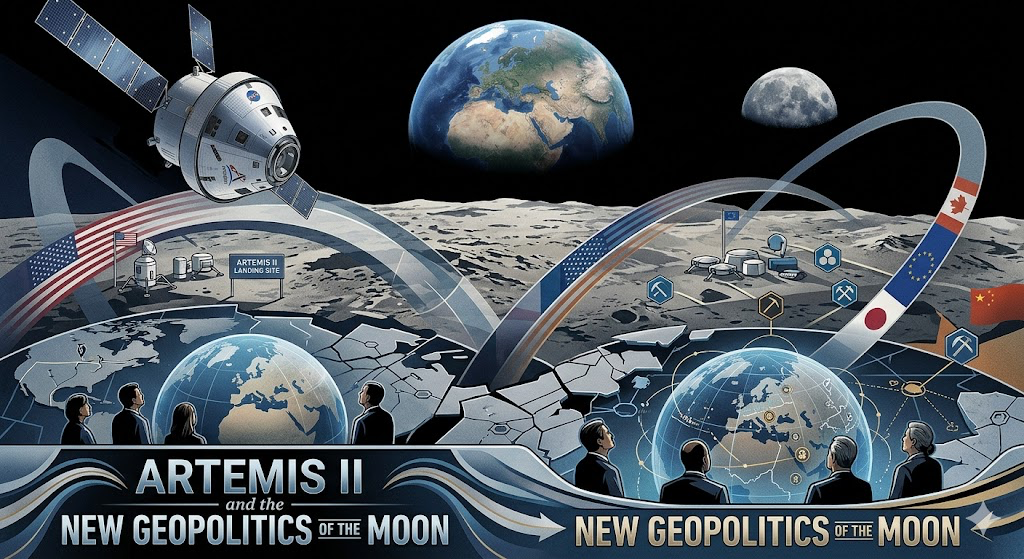
On April 1st, 2026, four astronauts left low Earth orbit for the first time in more than half a century. The mission was officially scientific, but the political signal it sent was a lot more interesting.
The mission
The Artemis II flight lasted ten days and took four North American astronauts on a free-return trajectory around the Moon.
At its furthest point, the Orion crew reached 406,771 km from Earth, which is a new distance record for human spaceflight.
The crew did not land on the Moon, and this is exactly what makes the mission worth analysing:
Artemis II was a stress test for the hardware, the international partnerships and the political signalling, all at the same time.
There are notably three things to keep in mind here.
Firstly, this was the very first crewed flight of NASA’s Orion spacecraft, which is the vehicle that is supposed to take astronauts down to the lunar surface from Artemis III onwards.
Secondly, Orion does not fly on its own : its life support, its power and its propulsion all come from the European Service Module built by ESA.
By design, every single Artemis mission is therefore a transatlantic mission.
Thirdly, the launch came less than two months after a successful test of China’s Long March 10A, which is precisely the rocket that is meant to send Chinese taikonauts to the Moon by 2030. The race is no longer something hypothetical.
From cooperation to multipolar disorder
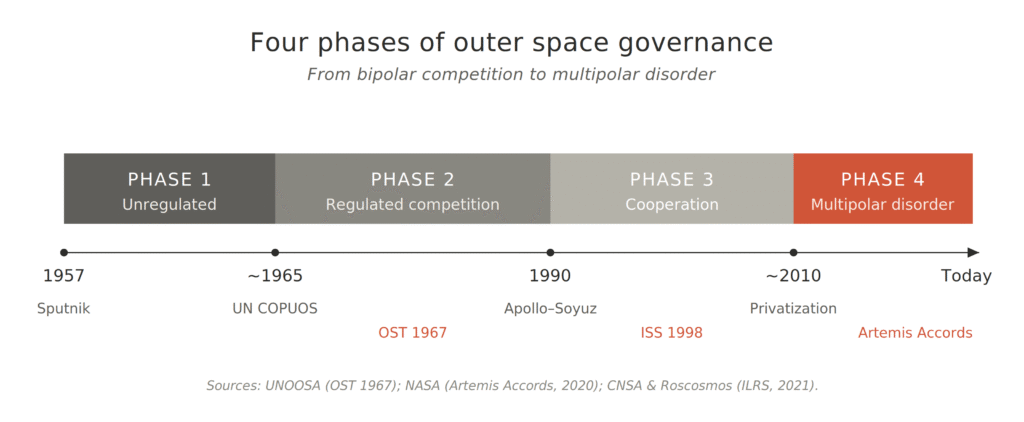
Space governance went through four main phases. The first one, just after Sputnik, was an unregulated bipolar competition.
The second one was anchored by the 1967 Outer Space Treaty (OST), today signed by more than 110 countries, and established space as res communis, meaning a common heritage with no national appropriation, no militarisation, and no territorial claims allowed. The third phase, between roughly 1990 and 2010, was a phase of cooperation symbolised by the International Space Station.
We are now in a fourth phase, which can be described as multipolar disorder.
Russia is leaving the ISS, the United States created a Space Force back in 2019,
and China and Russia signed an agreement in 2021 to build their own parallel lunar base, called the International Lunar Research Station.
Since then they have managed to bring on board countries like Belarus, Pakistan, Venezuela, Egypt and South Africa into the ILRS Cooperation Organization. The dominant logic today is no longer cooperation, it is assertion.
Two blocs, two visions of the Moon
Behind all the spectacular images of the launch lies the real question, which is the following : which legal regime will end up governing lunar activity in the coming decades?
Two architectures are currently competing for that role.
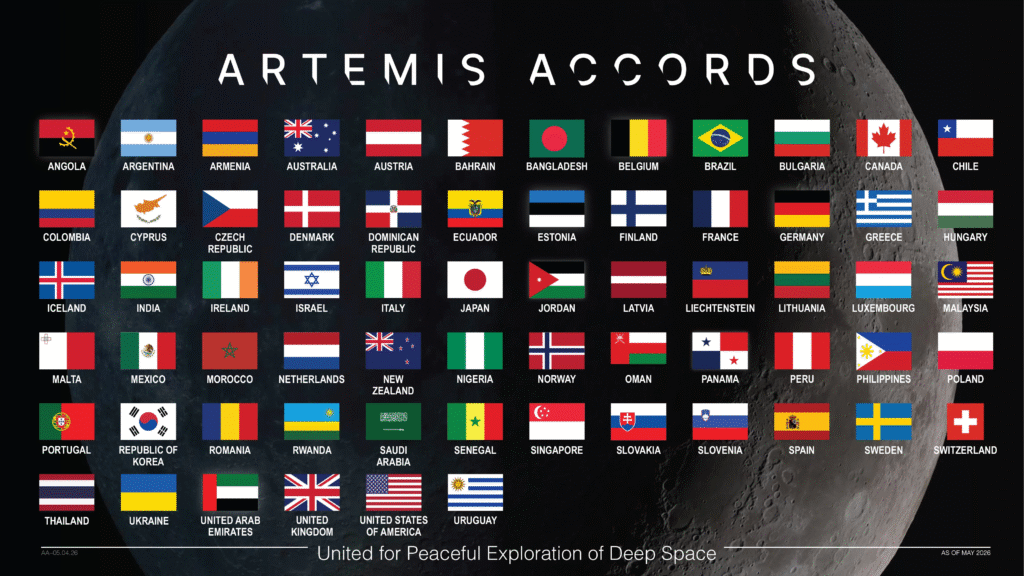
On the American side, we have the Artemis Accords, drafted by NASA and the U.S. Department of State and signed by 8 founding nations in October 2020. By May 5th 2026, they had already reached 66 signatories, with Ireland being the most recent one. The Accords are based on the OST but they introduce two innovations that are heavily contested.
The first one is the right to extract space resources without this being considered as “national appropriation”, and the second one is the concept of “safety zones” around active operations, which de facto creates exclusive operating areas.
Russia and China, who are both non-signatories, see this as a unilateral reinterpretation of the 1967 treaty.
On the other side, the China–Russia ILRS. Far more centralized: in China, a single state-owned contractor (CASC) coordinates almost the entire value chain.
Beijing has already tested its Lanyue lunar lander in simulated lunar gravity, and Chang’e 7 is scheduled for the lunar south pole later this year. Where Artemis multiplies partners, the ILRS centralizes execution.
Why the South Pole matters
The new lunar race is not about flags. It is about the south polar region.
Permanently shadowed craters there are believed to contain water ice usable for drinking water, oxygen and rocket propellant, alongside rare earth elements and helium-3.
India landed in the region in 2023; China’s Chang’e 6 returned far-side samples in 2024; Chang’e 7 will attempt a south pole landing in late 2026. NASA’s Artemis III, slated for 2027, targets the same area.
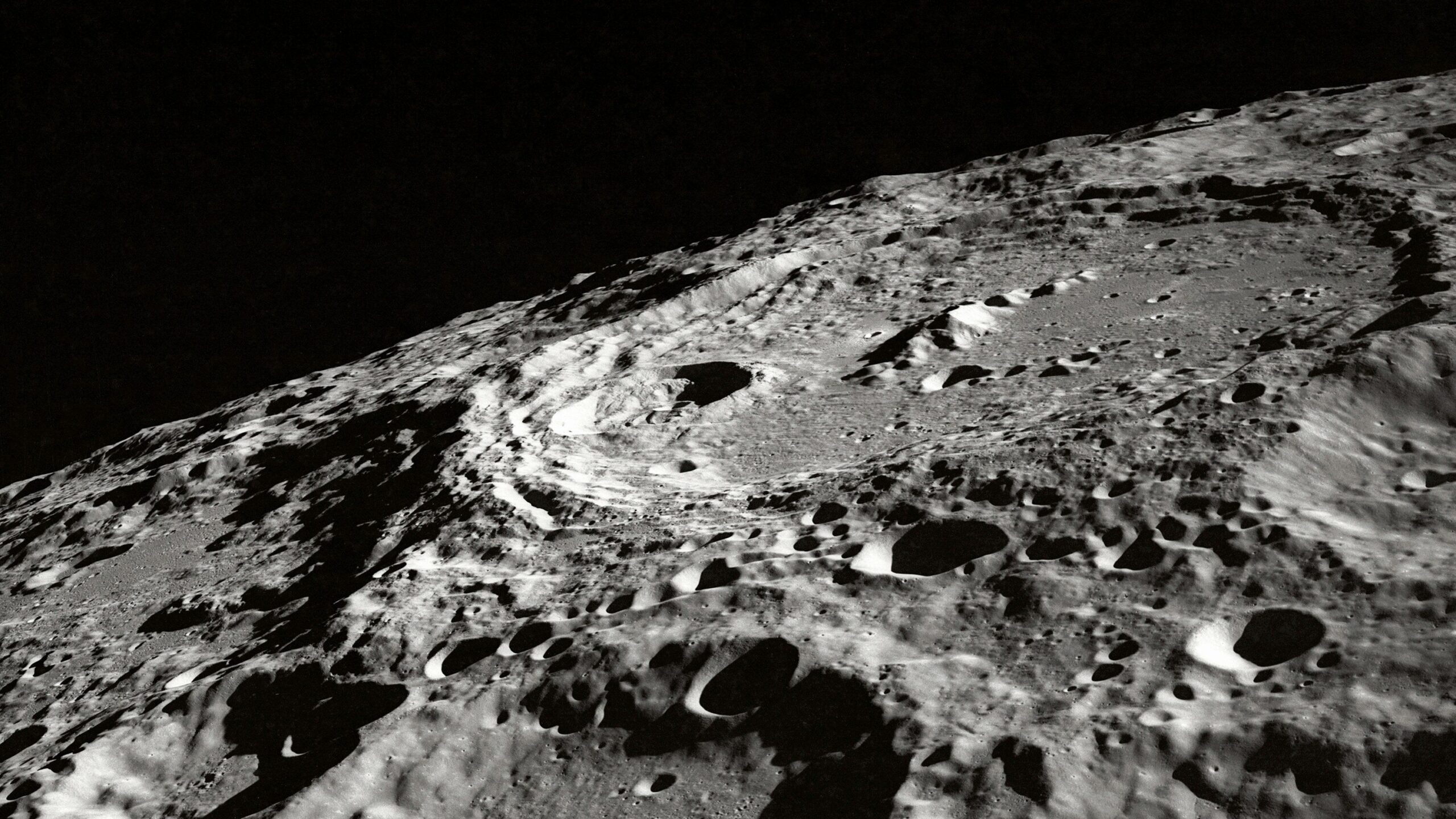
Under a strict reading of the OST, no state can claim sovereignty over a lunar region. Under the Artemis Accords, a state operating in a “safety zone” can effectively exclude others from a specific site. The first crewed actor to establish a sustained presence will, in practice, set the precedent that future regimes will inherit.
The business stakes
This contest unfolds atop a maturing commercial market.
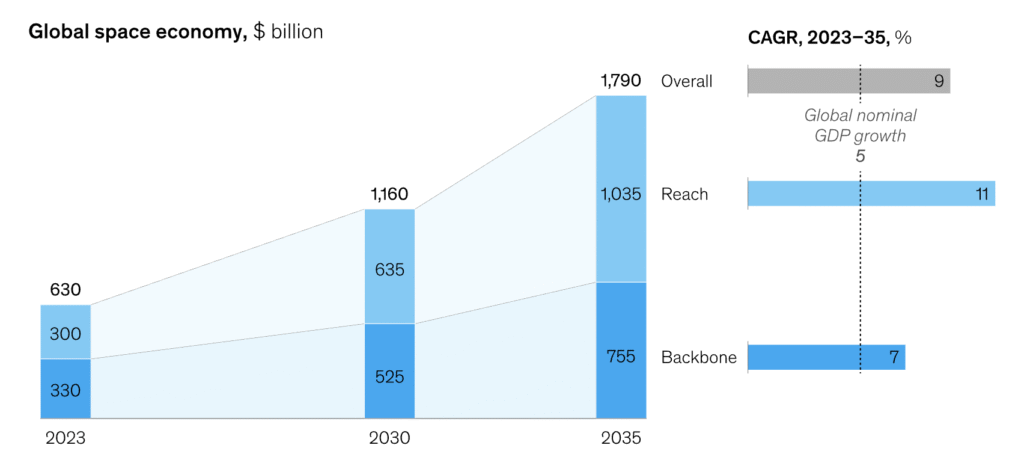
According to McKinsey Space Report,
the global space economy will be worth $1.8 trillion by 2035 (accounting for inflation), up from $630 billion in 2023.
Defense and sovereignty have emerged as the dominant growth drivers.
The European paradox is striking:
while Europe pursues strategic autonomy on AI, semiconductors and critical minerals,
the European Service Module makes every NASA lunar mission, by construction, transatlantic. The Moon is the one strategic domain where Europe has chosen integration over sovereignty.
Next steps
Artemis II was the first crewed lunar mission since Apollo 17 in 1972. It was also the clearest signal yet that the post–Cold War cooperative consensus in space is over. The next decade will not decide who reaches the Moon, both blocs will. It will decide whose rules govern what happens once they arrive.
You may also enjoy reading…