
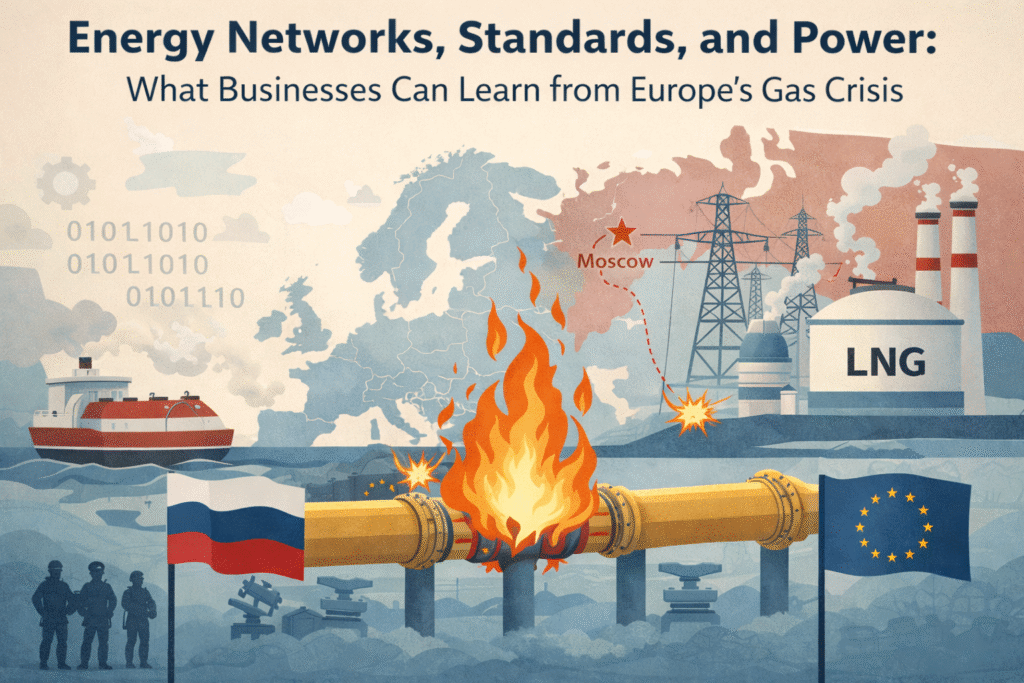
In the current global context, which is becoming increasingly unstable, energy is not just a geopolitical or economic issue. In this situation, energy has also become a matter of security, infrastructure and power.
Energy is a weapon, and nowadays States use it to gain power in Governments’ relations in a strategic way. This is just one of the key messages that emerged throughout our conversation with Adriano Ferrara (R&I EU Project Manager at UNI).
During his seminar entitled “Geopolitics and Standardization” and dedicated to geopolitics and energy networks, we did an in-depth analysis of how energy networks and technical standards have become key instruments of power for the States.
This analysis confirmed the interconnection between geopolitics and the control of energy resources.
This guest lecture was important especially due to the events that are happening nowadays, involving not just Governments, but enterprises as a whole.
Standardization as a geopolitical power
“Standardization is not just a technical process; it is a strategic tool that defines market access, economic influence, and technological leadership. The EU, China and the US compete to set global standards in key areas such as renewable energy, artificial intelligence, cybersecurity, and mobility. UNI, as part of the European standardization system, helps protect and promote European standards globally, ensuring that the EU maintains its role as a regulatory leader” (Ferrara, 2026)
A key topic of Mr Ferrara’s speech was “Standards”, seen not just as neutral, technical rules. Quite the opposite, they are a strategic instrument, able to influence the market, innovation and technological leadership.
On the global trade side, organizations such as ISO and WTO promote harmonization of the standards. This reduces the technical barriers between countries. However, the definition of the standards has become a competitive field within great powers (particularly the EU, the U.S. and China).
Ferrara specified it clearly: “who set the standards of the market basically set the trends”.
In other words, who defines the standards also contributes to shaping new technologies, economies and the overall competitive landscape.
This idea of standardization as a soft power is always present throughout the seminar, knowing that “standards shape global power dynamics” and that defining the standards means “setting the rules of the game”.
To give more context:
the EU is following a strategy aiming to increase its autonomy and technological leadership, especially in sectors like energy, digital transformation and sustainability.
The main insight here is that geopolitical competition comes not only from wars, sanctions or natural resources, but also from the ability to impose rules and procedures.
Energy infrastructures as a geopolitical instrument
The second important topic of the seminar was related to European energy supply dependence.
Mr. Ferrara synthesized it in just one, bold phrase, able to summarize the entire European experience from 2022 on: “energy dependence creates vulnerability”.
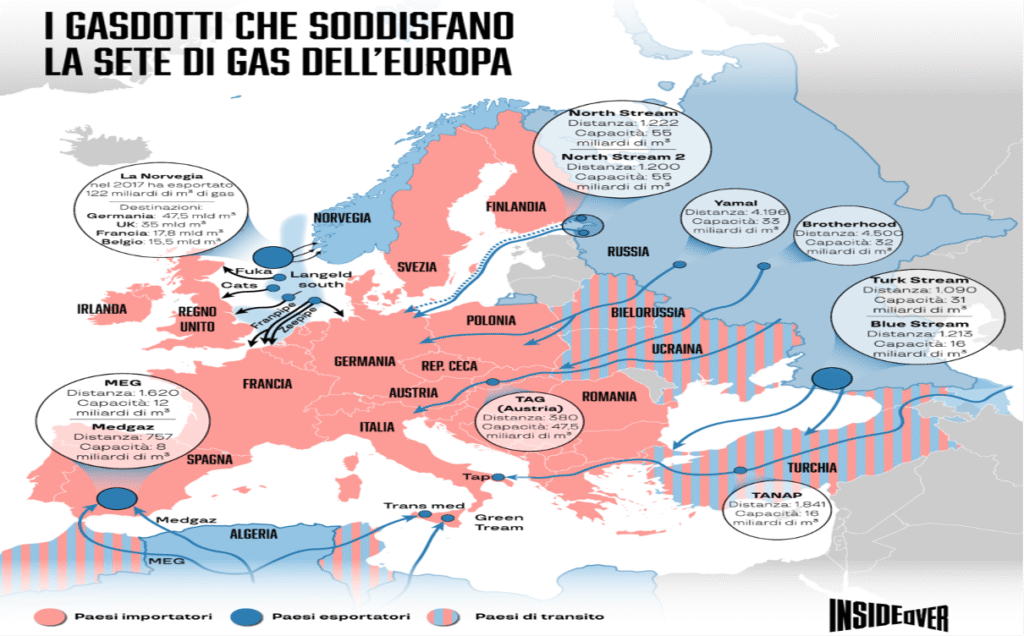
The graph above, used during the presentation, shows this issue clearly.
Before the Ukraine-Russia war, Russia was the main gas supplier for Europe, with around 130 bcm in 2021. This dependence represented a structural vulnerability for Europe, exposing the EU economy to geopolitical shocks.
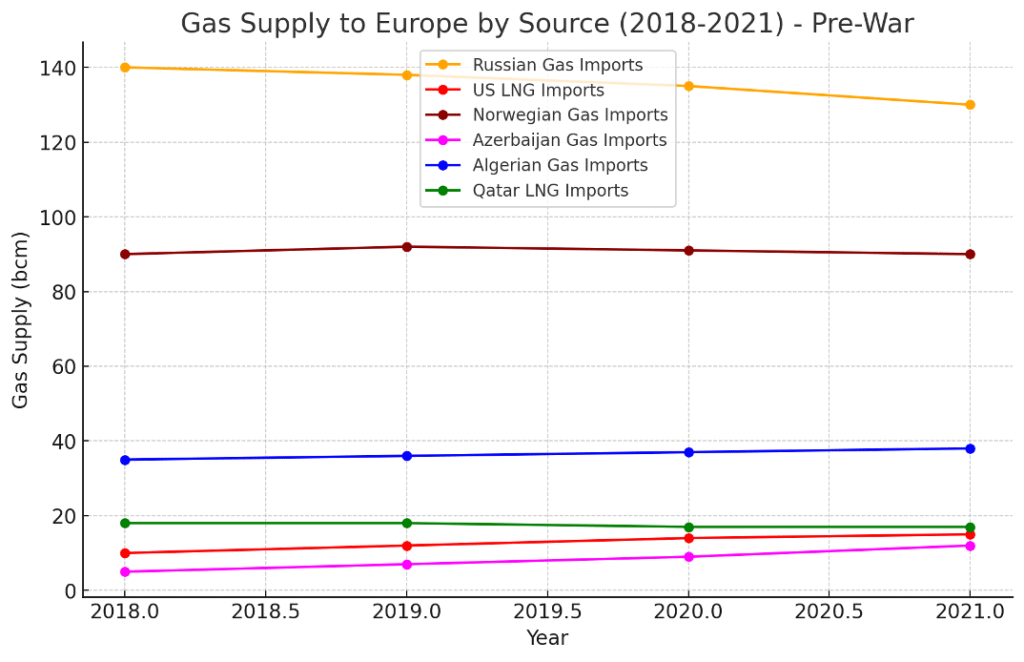
After the war, the European energy system saw a drastic transformation.
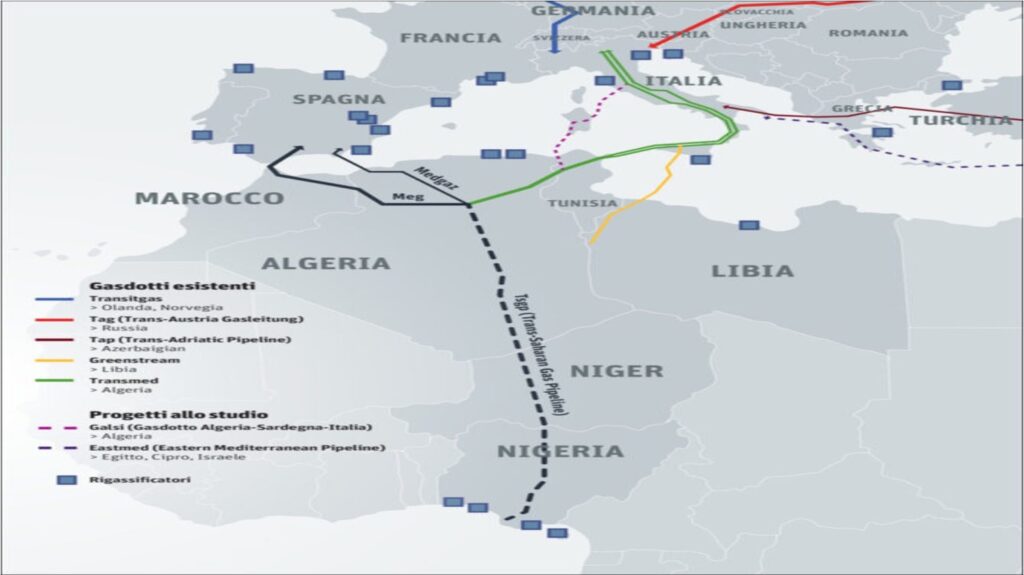
In 2024, based on data from Mr. Ferrara’s lecture, the Russian gas supply dropped to around 30 bcm. Norway became the main supplier via 3 main pipelines (Europipe I & II; Langeled Pipeline and Norpipe). At the same time, we also saw an increase in the supply from U.S. LNG, Algeria, Azerbaijan and Qatar.
But the main point of this gas supply shift in Europe is not just the drop of Russian gas. Indeed, it’s the fact that the European system has become more diversified (but also complex).
The dependence on just one supplier is now reduced, replaced by LNG. This is more flexible, but makes the european system more exposed to shocks on prices, logistics and geopolitical tensions. That means that energy security has improved, but it is still not stable.
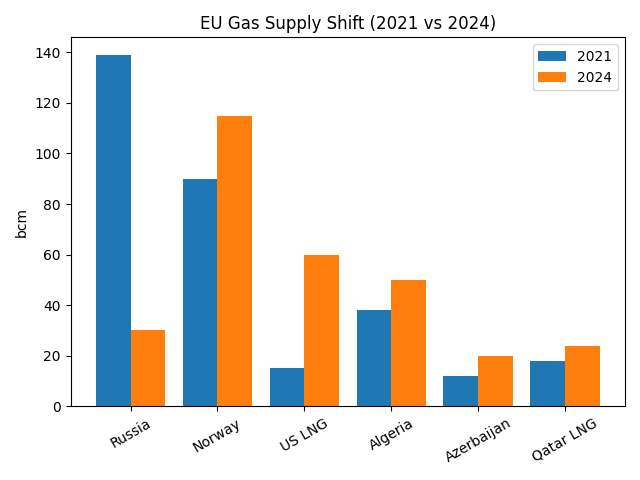
Additionally, Ferrara emphasized the role of infrastructural constraints.
Indeed, gas pipelines are not moved easily, so energy networks are quite rigid. That’s why diversification requires several years, investments and coordination within countries.
From Energy efficiency to energy security
One of the most important parts of the seminar is when discussing renewable energy and strategic security. In our discussion with Mr. Ferrara, we observed how energy transition is changing: “switching to renewable energy means also increasing our own strategic dependence […] and it’s a strategic asset for security”. This observation contrasts with the traditional idea that renewable energy is just an environmental choice.
Today, this option is also linked to geopolitics, and here comes the so-called “RePowerEU” strategy, to accelerate Europe’s Energy Transition and reduce dependency on Russian fossil fuels. This is obtained by diversifying energy imports and the usage of renewable energy capacity, to strengthen energy security.
Why is Standardization strategically important?
In this scenario, standardization is playing a crucial role, because it enables:
- interoperability and system integration within energy infrastructures
- security and reliability of energy supply
- regulatory harmonization between countries.
For example, as Ferrara explained during his seminar, “we need to rethink the pipeline, because we cannot mix hydrogen and gas”.
So, the development of new energy carriers, such as hydrogen, requires new, shared technical standards, because the already existing infrastructures are not directly applicable.
Additionally, standardization helps to bring innovation to the energy market,
because it allows the development and use of new technologies on an international scale.
Implications for businesses and current affairs
The 2026 energy crisis in Europe demonstrated how quickly the energy supply disruption could redefine entire industries, and so businesses.
This leads to three key points:
- The geopolitical risk must be integrated into companies’ operational and strategic decisions.
- Companies should monitor the evolution of norms and standards, potentially to gain a competitive advantage through easier access to markets.
- The energy transition implies both risks (such as price volatility, regulation uncertainty and infrastructures’ constraints) and opportunities (investments in energy renewables, bioenergy and new technologies).
Additionally, the European Commission recently confirmed that “no risks to security of supply are currently observed. Even though gas storage levels are below the average of the last 5 years, they remain stable and early storage injection will allow the EU to benefit from a longer injection period, and EU countries to adapt to market circumstances mitigating pressure on prices and avoiding end-of-summer rush to refill storages”. This makes the final message of the seminar even more clear.
As Ferrara suggested, the companies that are able to anticipate these changes and disruptions will be better positioned in the energy context (and in the competitive landscape overall). Diversification is necessary, but it doesn’t eliminate the risk completely: it just transforms it.
Europe and European companies have already moved in the direction of diversification of the energy supply, reducing the dependency on Russian supply, but they continue operating in a fragile context, exposed to geopolitical shocks and price volatility.
For that reason, energy networks, technical standards and security of the supply are not separate topics: they are part of the same current strategic challenge.
You may also enjoy reading…