
How China export controls reshaped global supply chains
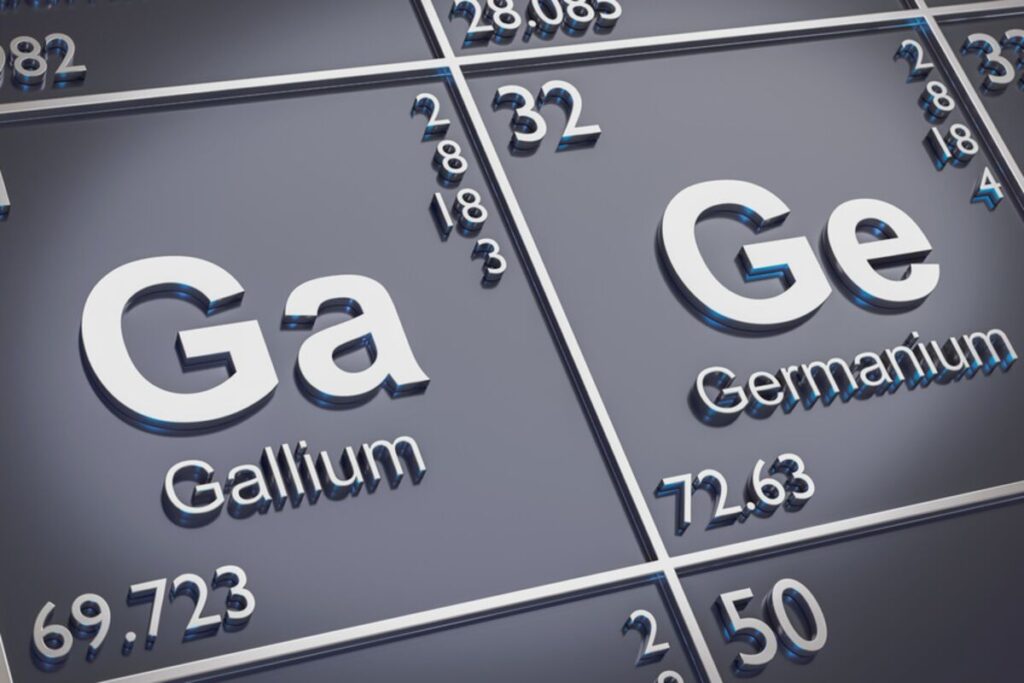
China’s gallium and germanium export controls have become a defining case study in supply chain weaponisation. In August 2023, global exports of both metals from China collapsed to near zero almost overnight. China is the world’s dominant producer of both. Market forces did not cause this collapse — a deliberate policy decision did. The measure originated in July 2023, when China’s Ministry of Commerce (MOFCOM) announced export licensing requirements for both metals, effective 1 August. Beijing officially justified the policy on national security grounds. It quickly demonstrated, however, how upstream material dominance can be weaponised. What followed was not simply a trade disruption. It was a controlled exercise in economic leverage.
This article examines China’s gallium and germanium export controls across four dimensions: the strategic importance of these metals, the structural foundations of China’s dominance, the escalation of restrictions, and the financial implications for the United States and its allies. These relatively obscure materials sit at the intersection of industrial chemistry, semiconductor technology, and great-power competition. Their trajectory reveals how economic statecraft is evolving in the 21st century.
The strategic importance of Gallium and Germanium in China export controls
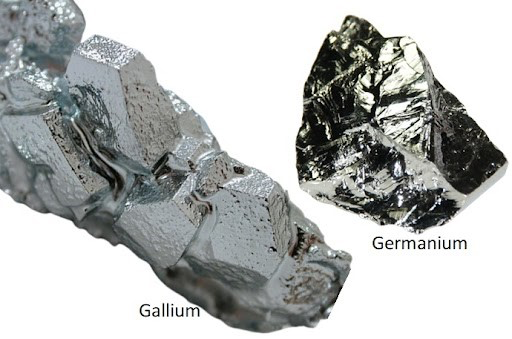
Gallium and germanium occupy a structurally fragile position within global supply chains. Neither metal is mined as a primary resource. Both are recovered as by-products of other industrial processes. Gallium is extracted during bauxite and zinc refining. Germanium derives from zinc processing and coal fly ash. This dependence on other commodity streams inherently constrains supply flexibility.
Despite their low public profile, their applications are critical to advanced technology. Gallium — particularly as gallium nitride (GaN) and gallium arsenide (GaAs) — is essential for high-frequency semiconductors, LEDs, and advanced defence systems such as radar and satellite communications. Germanium plays a central role in infrared optics, thermal imaging, fibre-optic networks, and high-efficiency solar panels used in space technologies. The US government designates both metals as critical minerals. Among all assessed materials, gallium carries the highest identified supply risk.
The foundations of China’s dominance in Gallium and Germanium
China’s dominance in gallium and germanium is not primarily a product of geology. It is a product of industrial strategy. Over the past decade, China has consistently accounted for more than 90% of global primary gallium production and roughly 60% of refined germanium output. The critical differentiator is not raw material access — those resources are geographically dispersed. It is control over processing capacity. China has built an extensive network of smelters, refineries, and chemical processing facilities. These convert intermediate inputs into usable metals. State-led investment and subsidised energy underpin the entire system. The result is a structural chokepoint in the global supply chain. Alternative producers cannot substitute Chinese output in the short term.
From regulation to coercion: the escalation of China export controls
In July 2023, MOFCOM introduced export licensing requirements for both metals, classifying them as dual-use materials with potential military applications. The immediate impact was severe. Chinese gallium exports fell from 6,876 kg in July 2023 to just 227 kg by October. Over the same period, germanium exports dropped from 7,965 kg to 590 kg.
This contraction must sit within the broader context of US–China technological competition. The United States had already imposed restrictions on advanced semiconductor exports through the CHIPS and Science Act and subsequent 2022 measures. China’s licensing move therefore reflects a reciprocal strategy — targeting upstream inputs rather than downstream technologies. Each side leverages its structural advantages against the other.
The escalation did not stop at licensing. In December 2024, China imposed a full export ban on gallium, germanium, and antimony to the United States. This marked a clear transition from regulatory oversight to explicit economic coercion. It also demonstrated how rapidly China can intensify supply chain tools once deployed.
Financial and macroeconomic implications of China export controls
The financial consequences of China’s export controls have been both immediate and measurable. Chinese domestic gallium prices rose by 18% by October 2023, while global prices surged by 68%. Germanium reached approximately $2,839 per kilogram by end-2023 — a 21% annual increase. These movements represent significant input cost shocks for semiconductor manufacturers.
At the macroeconomic level, equilibrium modelling by the USGS estimates that a complete one-year restriction of China’s gallium exports would reduce US GDP by approximately $3.1 billion. Simultaneous restriction of both metals raises the projected loss to $3.4 billion. Semiconductor manufacturing absorbs more than 40% of that impact. Two structural features amplify this vulnerability further. First, the absence of liquid futures markets for either metal forces firms into physical stockpiling or long-term contracts rather than financial hedging. Second, a stark asymmetry in strategic reserves exists: while the United States maintains a germanium stockpile, the Department of Defense’s National Defense Stockpile does not include gallium. That gap leaves the gallium segment of the supply chain disproportionately exposed.
Conclusion: China export controls and the rise of supply chain geopolitics
China’s gallium and germanium export controls demonstrate a fundamental shift in how states exercise economic power. Instead of relying on tariffs or financial sanctions, Beijing leveraged control over a critical supply chain node to achieve strategic objectives with speed and precision. A licensing requirement produced effects comparable to a full trade embargo — at minimal diplomatic cost. The deeper challenge is temporal. Building alternative processing capacity outside China requires years of sustained investment. The vulnerabilities this episode exposed therefore persist in the short term, regardless of policy intent in Washington or Brussels. Gallium and germanium are not peripheral concerns. They are early indicators of a wider contest over the infrastructure of technological power.
You may also enjoy reading…