
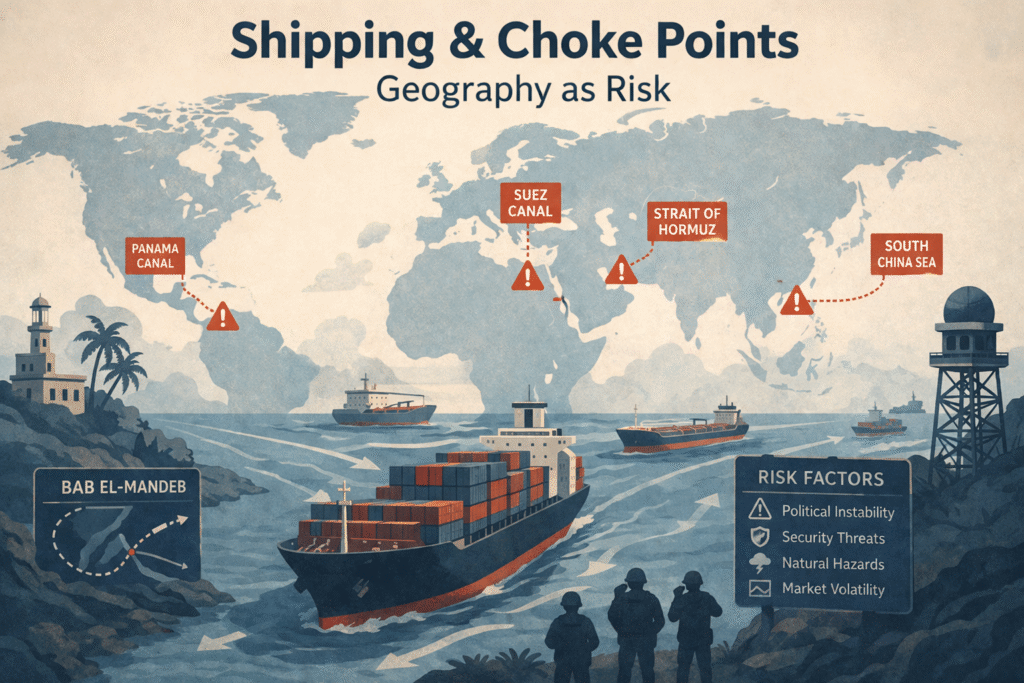
Globalization is often described as a world of seamless flows. Goods move, capital circulates, and supply chains stretch across continents. Yet global trade is far less fluid than it appears. In practice, much of it still depends on a small number of narrow maritime passages, where geography compresses movement into a few vulnerable corridors.
There may be no better example than the Strait of Hormuz. Recent tensions in the Middle East have shown again how a local disruption to maritime traffic can quickly become a global concern. They have also reminded markets how sensitive international shipping remains. This matters because more than 80% of world trade by volume moves by sea, according to EIA.
For that reason, businesses and governments need to pay close attention to maritime choke points. These are not just narrow passages on a map. They are strategic bottlenecks through which a disproportionate share of trade, energy flows, and commodity movements passes. The Strait of Hormuz, Bab el-Mandeb, the Suez Canal, the Panama Canal, and the Strait of Malacca are among the most important. They are not just geographic features. They are critical nodes in a wider system of dependency.
Why choke points matter
Choke points matter because they concentrate risk. When a large share of trade passes through a narrow corridor, even a limited disruption can have outsized effects. This is what creates asymmetric risk: a local event can produce global consequences.
Recent events have made this clear. The Red Sea crisis exposed the vulnerability of the Suez corridor. At the same time, drought conditions disrupted operations in the Panama Canal. Under normal conditions, the Suez corridor carries around 15% of global maritime trade, while the Panama Canal handles about 5% of seaborne trade. In periods of stress, these routes become more than regional concerns. They affect transit times, insurance costs, freight rates, and supply-chain reliability.
The Strait of Hormuz illustrates this logic even more clearly. It is one of the world’s most important oil chokepoints. According to the International Energy Agency, about 20 million barrels of oil per day pass through the strait, equal to roughly a quarter of global seaborne oil trade. As a result, tensions in this area do not remain local for long. They quickly affect shipping, insurance, and energy markets worldwide.
The logic is simple: chokepoints create delays, delays create costs, and costs create vulnerability.
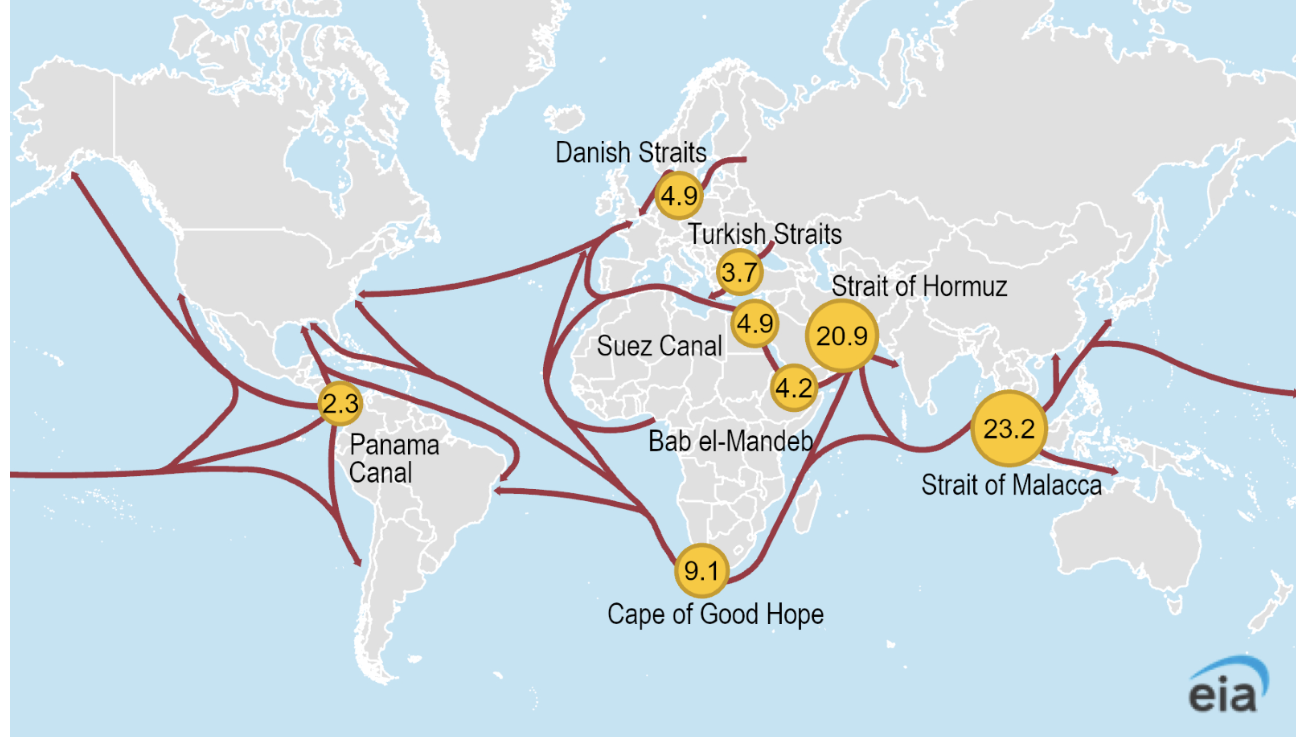
Source: U.S. Energy Information Administration (EIA) analysis, based on Vortexa tanker tracking; World Bank; and Panama Canal Authority data, using EIA conversion factors and calculations
From local disruption to systemic shock
Not all chokepoints generate the same type of risk. Each one reflects a different mix of geography, politics, climate, and infrastructure constraints.
Security risk in Suez and Bab el-Mandeb
The Suez Canal and Bab el-Mandeb show the security dimension most clearly. Both routes are highly exposed to regional instability, armed conflict, and attacks on commercial shipping. The recent crisis in the Red Sea did not only affect the surrounding region. It also disrupted trade between Europe and Asia, pushed up insurance premiums, delayed deliveries, and added inflationary pressure in multiple economies.
Some vessels had to reroute around the Cape of Good Hope, adding ten days or more to the journey. That increased fuel costs, transport costs, and insurance expenses. A canal designed to shorten distance suddenly became a reminder of how quickly geography can reshape economics.
Climate risk in the Panama Strait
The Panama Canal highlights a different kind of vulnerability: climate risk. Canal operations depend heavily on water availability. During periods of drought, traffic through the canal becomes constrained. This shows that maritime infrastructure can come under pressure even without war or political confrontation.
Because Panama handles about 5% of global seaborne trade, disruptions there do not stay local. They ripple outward through shipping schedules, logistics planning, and trade flows across multiple regions.
Strategic concentration in Hormuz
Hormuz remains the clearest example of strategic concentration. What makes it so important is not only its location, but the combination of high volumes and limited alternatives. A narrow passage carries an enormous share of global energy flows, and there are few practical substitutes.
That is why disruptions or threats in Hormuz affect far more than the immediate area. They shape oil prices, market expectations, freight strategies, and risk calculations across the global economy. This helps explain the persistent international attention on the Gulf region.
The role of the Strait of Malacca
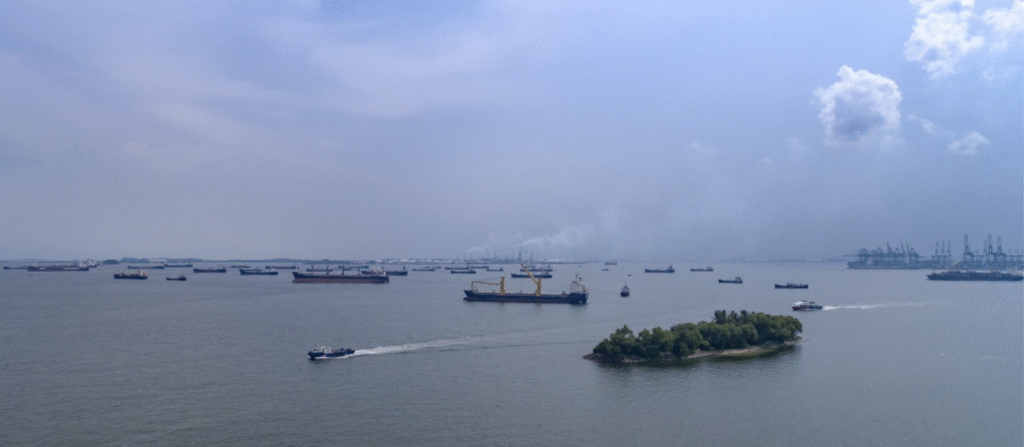
The Strait of Malacca plays a similar role in Asia. It is a vital route for trade and energy flows between the Middle East and East and Southeast Asia. Any disruption there would affect some of the world’s most important manufacturing and import-dependent economies.
As for the Panama Canal, it illustrates another type of risk – climate risk, which is at the same time trade risk. Operations of the Panama Canal depend on climatic conditions because during droughts it is unable to provide its services. The situation reveals that the geography is also vulnerable to natural processes, and infrastructure may face troubles without war, political sanctions and military actions. Since Panama handles about 5% of all maritime trade worldwide, these problems will surely extend their effect to a larger part of the globe.
As for Hormuz, it is definitely the best example of the increased risk due to strategic concentration. This passage is not merely one among other similar geographical features of the world, but it is characterized by high volume of oil transported through it and smallnumber of alternatives available. That is why problems in this area are likely to spread to prices, expectations and strategies of actors. This process explains, to a certain extent, current international interest to Middle East region.
Strait of Malacca plays its own role in trade and energy flow between different regions, specifically, the transfer of oil from Middle East region to East and South-East Asia.
Source: ISPI
Beyond the main choke points
The maritime system extends beyond the best-known chokepoints. In addition to Hormuz, Suez, Panama, and Malacca, global shipping also depends on secondary passages and alternative routes that become more important during crises.
In normal times, these routes often remain in the background. But when war, climate disruption, or geopolitical rivalry affects a major corridor, peripheral routes suddenly gain strategic relevance. Rerouting does not eliminate vulnerability; it often shifts it elsewhere.
The Arctic is a good example. As ice cover declines and interest in Arctic shipping increases, these routes are receiving more attention as possible links between Asia and Europe. In theory, some of them could shorten travel times. In practice, however, they still face severe limits: extreme weather, seasonal access, weak infrastructure, and growing strategic competition.
The key lesson is straightforward. Maritime vulnerability does not stop at the most famous chokepoints. It also extends to secondary channels that may become critical under stress. Today’s major bottlenecks show where risk is concentrated now. Secondary routes may reveal where the next wave of geopolitical friction could emerge.
| Choke point | Million barrels per day | % on total |
| Strait of Malacca | 23.2 | 29.1% |
| Strait of Hormuz | 20.9 | 26.2% |
| Cape of Good Hope | 9.1 | 11.4% |
| Suez Canal and SUMED Pipeline | 4.9 | 6.1% |
| Danish Straits | 4.9 | 6.1% |
| Bab el-Mandeb | 4.2 | 5.3% |
| Turkish Straits (Dardanelles) | 3.7 | 4.6% |
| Panama Canal | 2.3 | 2.9% |
| Other | 6.6 | 8.3% |
| World maritime oil trade | 79.8 | 100.0% |
Source: U.S. Energy Information Administration (EIA) , Short-Term Energy Outlook, February 2026, and EIA analysis based on Vortexa tanker tracking and Panama Canal Authority data, using EIA conversion factors and calculations
What businesses and governments should learn
For companies and policymakers, the main lesson is not that every crisis can be predicted. It is that exposure can be mapped.
Businesses should treat chokepoints as strategic variables, not as background conditions. The first step is to identify where suppliers, transport routes, and critical inputs depend on narrow maritime corridors.
The second is to distinguish between direct and indirect exposure. A company may never ship through Hormuz or Suez itself, yet still suffer from higher energy prices, delayed intermediate goods, or rising freight and insurance costs caused by disruptions there.
The third step is to move beyond pure efficiency. Resilience matters more in a chokepoint world. Route diversification, inventory buffers, dual sourcing, and closer monitoring of geopolitical and environmental signals can all reduce exposure.
Governments face a parallel challenge. For them, chokepoints are not just commercial vulnerabilities. They are strategic pressure points. This means investing in infrastructure resilience, securing alternative supply routes, strengthening maritime security cooperation, and reducing excessive dependence on single corridors for critical imports and energy flows.
In an era of geopolitical fragmentation, the ability to anticipate and absorb disruption at these bottlenecks is becoming a core element of economic security.
The broader point is simple. Global trade is not flat. It is concentrated, physical, and vulnerable. Choke points show where geography compresses risk into narrow corridors. In shipping, geography is not just where disruption happens. Geography is risk.
You may also enjoy reading…