
How Sudan’s civil war became a regional power contest is a critical development that the international community can no longer afford to ignore. What began in April 2023 as a localized power struggle has transformed into a high-stakes geopolitical battlefield. Consequently, Sudan is now a “forgotten war” where massive global consequences are unfolding in silence. While mainstream media often overlooks the crisis, the conflict is actively reshaping the geopolitical risk premium and threatening the stability of the entire Red Sea corridor.
From Revolution to rivalry
The roots of this war lie in Sudan’s failed political transition after the 2019 overthrow of Omar al-Bashir. Initially, the removal of Bashir by mass protests created hope for democratic reform. However, a fragile power-sharing arrangement between civilian leaders and the military quickly dissolved.
The subsequent power struggle between General Abdel Fattah al-Burhan’s SAF and Mohamed Hamdan Dagalo’s (Hemedti) RSF reached a breaking point in April 2023. According to Reuters, the core dispute centered on the integration of the RSF into the formal military hierarchy. This failure to unify the security sector directly triggered a nationwide conflict that effectively ended the transition to civilian rule.
A fragmented battlefield
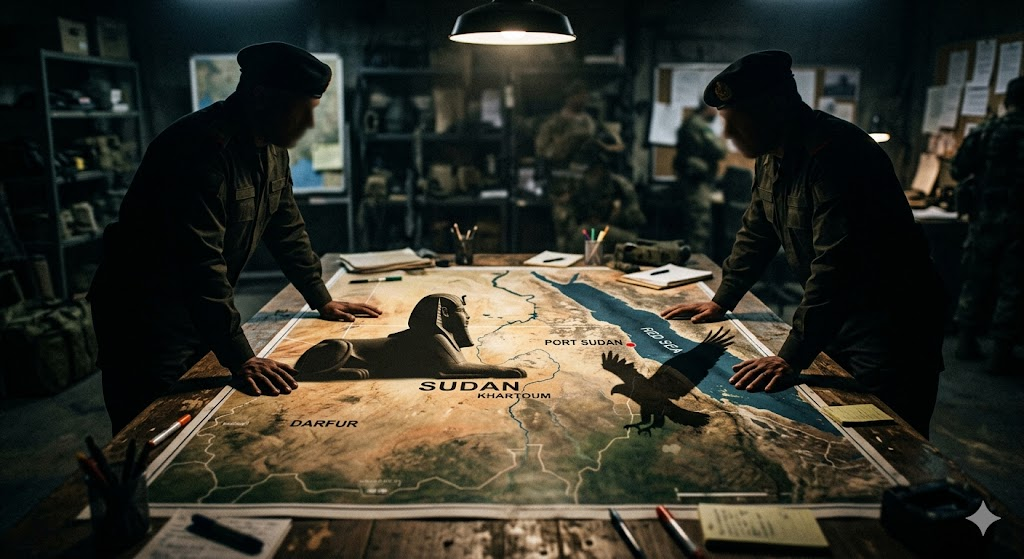
Today, Sudan is a patchwork of competing zones of influence. The SAF currently controls the eastern and central regions, maintaining its administrative base in Port Sudan. Meanwhile, the RSF remains deeply entrenched across Darfur and large sections of the west.
This fragmentation has caused a total collapse of central authority. As local militias proliferate, the conflict has shifted from a conventional war into a localized struggle for survival. You can track how these shifting fronts contribute to broader instability in our analysis of shipping & choke points, where geography itself becomes a primary source of risk.
Why Sudan matters beyond its borders
Sudan’s geography explains why foreign powers refuse to remain neutral. The country sits at the junction of the Sahel, the Horn of Africa, and the Red Sea. Therefore, control over Sudanese territory dictates:
- Maritime Security: Access to the Red Sea shipping lanes.
- Migration Corridors: Influence over major transit routes toward Europe.
- Strategic Geography: Sudan serves as a bridge between the Arab world and Sub-Saharan Africa.
The Council on Foreign Relations highlights that Sudan’s instability is no longer contained within its borders; it is a contagion affecting every neighbor.
The foreign powers shaping the war
External actors have fundamentally reshaped the trajectory of the war. Currently, regional powers provide the logistical and financial lifeblood for both factions:
- Egypt: Historically aligns with the SAF to ensure a stable, traditional military state.
- The United Arab Emirates: Analysts suggest the UAE supports the RSF to protect its commercial interests, though Abu Dhabi officially denies direct involvement.
- Russia: Seeks a permanent naval base on the Red Sea and maintains a grip on resource extraction risks.
- Saudi Arabia: Navigates the conflict through high-stakes diplomacy to prevent a total collapse of Red Sea security.
War economies and resource competition
Sudan’s conflict is fueled by more than just political ideology; it is a war for resources. Specifically, the gold trade has become the primary engine of the conflict. The RSF has built an extensive smuggling network that bypasses formal state institutions.

Consequently, militias have transformed into economic authorities. They control checkpoints, trade routes, and local markets. This “war economy” makes peace negotiations difficult because the commanders find the conflict highly profitable. For a deeper look at these dynamics, see our article on energy transition and new global crises, which explores how resource competition drives modern instability.
The humanitarian collapse
The human cost of this regional contest is staggering. According to Al Jazeera, millions have been displaced, and famine conditions have emerged in several regions.
Both sides have used starvation and the destruction of hospitals as tactical weapons. This state failure is not a byproduct of the war; it is a deliberate strategy to exert control over civilian populations. Furthermore, the international community’s indifference has only worsened the humanitarian trajectory.
What comes next
The future of Sudan appears increasingly bleak. Without a decisive military victory or a significant shift in foreign support, the country faces a high risk of permanent partition. We are likely looking at an entrenched proxy conflict that could last for a decade.

The primary diplomatic challenge remains the lack of a unified international response. Until external powers decide that a fragmented Sudan is more dangerous than a stable one, the global risk environment will continue to deteriorate.
References:
- Beyond the Conflict: Sudan’s Thirty-Year Economic Setback
- The Drone War in Sudan: 1,000 Aerial Attacks Since 2023
- Sudan and the Red Sea Front of the Saudi-Emirati Rift
- The Specter of Genocide: El Fasher and the West
You may also enjoy reading…